In celebration of the release of the new Tragically Hip album, In Between Evolution, and the Hip’s big Canada Day Concert at Toronto’s Molson Amphitheatre, ChartAttack is declaring June 25 – 30 “Tragically Hip Week.” Leading up to July 1, we’ve been posting stories culled from a recent interview with Hip singer Gord Downie.
Here’s the last installment:
The looming NHL strike/lockout may cause irreparable damage to the good name of hockey, but The Tragically Hip will continue to mine its most dignified moments in song. “Heaven Is A Better Place Today,” the first track on The Hip’s new album In Between Evolution is dedicated to Dan Snyder, the Atlanta Thrasher hockey player who was killed in a car accident last fall.
Synder died in October from the wounds he suffered when, as a passenger, he was thrown from teammate Dan Heatley’s Ferrari when Heatley lost control of the car, causing it to crash. Heatley broke his jaw and suffered a leg injury in the crash.
This would be far from the first time The Hip have used the world’s fastest game as a muse. “Fifty Mission Cap” is about the mystique behind Bill Barilko’s last goal/death, the song “Fireworks” is hockey-related and leadman Gord Downie has published a poem called “The Goalie Across The Street.”
In typical Hip fashion, though, Downie’s lyrics have layers of meaning that go beyond eulogizing a hockey player.
“I don’t know if it’s about anything so much as it’s a collection of, I don’t know, things people say to comfort each other, perhaps? Or themselves?” says Downie, who then sings one of the lines from the song to help articulate his explanation. “‘If and when you get into the endzone, act like you’ve been there a thousand times before.’ Like, it’s an ethos, it’s sort of ‘be cool, buddy.'”
Downie says it was the honour and dignity that Snyder’s fellow Thrasher teammates exemplified in the face of crisis which compelled him to write the song. The sight of young, strong men mourning a comrade’s senseless death has rather worldly parallels that aren’t to be ignored, either. Most importantly though, the song is about how bravely people face death.
“No one ever asks them [hockey players] anything else except about hockey. And around the events that you’re talking about, the one common denominator is that there’s nowhere to hide a conversation around death. There’s no easy, quick, humourous aside — unless you’re Irish — that gets you out of it. And people see it and rise to those sorts of occasions and say the correct thing. As close to correct as they can,” says Downie, who then sings/paraphrases some more from the song to articulate his point. “‘And heaven is a better place today because of this, but the world is not the same’… mmmmmmm… ‘don’t blame, but don’t say that people lose people all the time anymore.’
“And with this line, I guess again, you can take it broader. One could say you can’t treat these men’s lives with a soundbite. People lose people all the time. And death is a natural part of life, of course… but still.”
This story was originally published June 30, 2004 via Chart Communications.
There’s something surreal about seeing one of the country’s biggest and most iconic bands play in a small club in Toronto’s perennially underground Kensington Market.
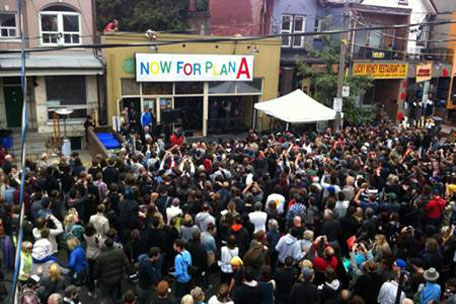
The crowd packed into the back room of Supermarket — renamed “Now For Plan A” Headquarters for the duration of The Tragically Hip’s three day residency in celebration of the release of their brand new album of the same name — can barely believe what’s about to happen as they wait for the band to take the stage for their first in a series of free mini-sets they’re playing throughout the day.
Despite the fact that The Hip stopped foot traffic with a number of surprise performances the day before during one of the artisan market neighbourhood’s beloved Pedestrian Sundays, despite the widely publicized promise of more shows on Monday and Tuesday, and despite the fact that the wristbands we were given at the door prominently display the band’s name in bold black letters, the fans around me nervously joke that the whole thing might be a ruse, that some no-name band who didn’t write Canadian classics like “Courage,” and “Ahead By a Century” will promptly take the stage at 3 p.m. on a Monday afternoon and dash all of their dreams.
It takes the appearance of all five founding members of the band — guitarists Paul Langois and Rob Baker, bassist Gord Sinclair, drummer Johnny Fay and, of course, singer Gord Downie — on stage to finally convince them that this is really happening.
The Tragically Hip, the band that have been filling Canada’s arenas for over two decades with stories of wrongfully convicted killers, tragic hockey players and young love blossoming in the face of the cold war, somehow seem both larger than life and completely at home amongst the few hundred fans who have skipped work and school to see them play. Downie shares conspiratorial smirks with the crowd as they launch into Now For Plan A‘s opening track, “At Transformation.” Then they encourage a singalong to “Grace, Too” before capping things off with a chilling take on another new song, “Man Machine Poem.”
But after the band finish their three-song set — and wrap up a genial autograph session in which the band trade jokes with fans as they sign every last piece of Hip memorabilia and Plan A vinyl — I find myself in a scenario that makes everything that happened before it seem normal and mundane by comparison: actually sitting down and talking to The Tragically Hip.
As I trade greetings, shoe compliments and, somewhat inexplicably, neck tattoo jokes with Rob Baker and Gord Downie, I decide to start things on a light note. I ask if the title of the song “Streets Ahead,” a phrase that became a running joke on an episode of the cult TV show Community, was inspired by the character of Pierce Hawthorne (played by Chevy Chase) and his use of it.
“Well then, I understand,” Downie says with a laugh. “No. I don’t know.”
I try to explain the joke and the use of the phrase in the context of the episode, but it’s too late. I have unwittingly started a feud between the lead singer of The Tragically Hip and a fictional character.
“I’m just incredulous, sort of like… aghast and really impressed by that kind of convincingness. ‘I coined that!'” he muses. “Anyway, you tell him I’m looking for him.”
We move on to more serious topics after that, starting with their lyrics. For a band that made their name on storytelling epics like “Wheat Kings” and tongue and brain-twisting tunes along the lines of “Poets,” Now For Plan A feels like a departure. Over time, the dense wordplay and metaphors that characterized their work seem to have evolved into more oblique and sparse imagery, with relatively simple phrases often repeated like mantras. The difference was particularly noticeable during their performance when the thoughtful and wordy “Grace, Too,” from the band’s 1994 album Day For Night, was juxtaposed with the more stark and obscure “Man Machine Poem.”
I ask if they feel that their lyrics have become more abstract over time. Downie mulls it over.
“Abstract? No. I think… visceral, for sure. But again, a practical, not a mystical kind of thing. I said to the guys, ‘Give me five things each. Let me just react to something.’ And they did, knowing a sort of improvisation is better than anything you can write — spontaneity. And so certain songs came like that. ‘Man Machine Poem’ is an example. It came very quickly and I really did want to screw with it. So what did you call it? Impressionistic? No, you said abstract,” he pauses and considers the word again.
“Maybe.”
Watch Tragically Hip’s “Machine Man Poet” Video
We move on to the sound of the album, which mixes meaty, Fully Completely-esque bar rock with the more introspective and occasionally haunting sound they’ve been nurturing since Trouble at the Henhouse and “Ahead By a Century.”
Baker takes over.
“I don’t think you ever leave stuff behind,” he says. “You know, we’re a rock ‘n’ roll band. We know what we do well and you try and learn from everything you do and carry that forward into what you do next. We had great experiences making the last bunch of records and they’re great learning experiences. And we carry that forward, and some of it is ‘Yes, we want to take this and we want to leave that.'”
Downie leans over and asks his guitarist a question.
“With Fully Completely, did we know those songs really well before we went in?” he says. “We went over to England to do them, so I bet we did. We really worked the shit out of them.”
“Well, it was a mixed bag with Fully Completely,” Baker says, reminding him. “About half the album we really knew and had road tested and there were about five songs that we hadn’t.”
“It’s like this record in that regard,” the singer offers.
Baker recalls feeling frustrated with Fully Completely at first, that the songs he loved playing so much on the road sounded “sterile” on the record.
“You never know,” he shrugs. “When you walk out of a studio after making a record, you feel pretty shattered. Like, I don’t know what I’m doing. I can’t play the guitar or… it can be a pretty brutal experience sometimes. And I remember walking out of Fully Completely feeling that way.”
“What brings you back?” Downie asks, stroking his chin in mock-seriousness.
“Because you go out live and it’s like ‘Yeah. This is really good. These songs are good. Some of these songs really have life.'”
I ask Baker if he’s reached a similar level of acceptance with Plan A yet.
“Some of these songs we’ve been playing live for two years now,” he replies.
“We knew them well,” Downie agrees. “For various reasons, the record was held up and delayed, but it just meant that we would sort of woodshed and really work the tunes, like we did in the earliest days, because you only had limited amounts of studio time to go forward.”
“We never made a record so quickly as this record,” Baker interjects.
“And then we went in, here in [Toronto neighbourhood] Parkdale, on Noble Street, and cranked it out in 10 days, really,” Downie continues. “And so those sort of sonic differences or sonic similarities might be that, might be that we knew our songs well before we started singing them, as Dylan says you should, and then recorded them knowing everything, going through those elusive things like emotion and performance and then you’re close. Then you’re close on a recording. But we just played ‘Modern Spirit’ yesterday for the first time live out here in Kensington and it just jumped into where it should be. You know, it’s there, but now it’s exactly where it should be. But it just took 10ccs of Kensington Market.”
“Sometimes it feels like the songs on the record are a template for what the songs are supposed to be. We kind of freeze dry them in recording, but then you have to thaw them out and microwave them up on stage, serve them up and it’s often very different. Sometimes it’s way better,” says Baker. “Records are like… they’re very strange. I always think we’re in the… our chosen profession is performing music live. That’s what we do and the records feed into that, the songwriting and everything else.”
With record culture giving way to internet-fueled singles and Radiohead-style releases, though, will a legacy band like the Hip continue to make traditional albums in the future?
“I don’t think record culture’s gone,” Baker replies. “There are people who are very devoted to it.”
“And they’ll always want to come together with other people,” Downie adds. “Which is why we’re here doing this today. I’m not going to say ‘It’s still a people business!'” he laughs, adopting a cartoonishly earnest voice. “But it is. People who are into music want to talk to other people who are into music and that’s where record stores… Like the passing of Sam Sniderman last week. My God, it just reminded people of what a hub that was, for a million reasons. You’re coming in from Newmarket, ‘We’ll meet you at Sam’s,’ and everyone knew what that meant. Music meant… but it still does mean that stuff. It’s just because the hubs are leaving and gone…”
Watch Tragically Hip’s “Ahead By a Century” Video
“You know today’s the 30th anniversary of the CD,” Baker points out. “The sale of the very first CD was 30 years ago today.”
“I promised I wouldn’t cry,” Downie deadpans.
This rather conventional interview happening in the midst of a rather unconventional promotional event is about to take a turn for the strange.
“Yeah, you know what? The very first CD was Billy Joel, and it was a horrible day for music, really. Because I think it was…”
“Wait a second,” Downie stops. The horror of the situation slowly dawning of him. “The first CD down the line…”
“It’s like the invention of the Big Mac to me,” Baker muses.
“Billy Joel,” sneers a stunned Downie, pounding the table in front of him.
“Billy Joel,” Baker confirms.
Downie collapses back into the couch, giggling. “A Big Mac sounds way better. The Billy Joel burger!”
“Yes, the Billy Joel burger was served today out of the window to a passing car.”
“I heard a guy on the radio today say that the NHL was like KFC,” Downie offers, like it’s the most logical segue in the world. “It’s a franchise and if people in the market don’t like your chicken, you’ve got to go.”
I try to argue that most Canadian will probably never be able to look at hockey in such clinical terms and that the way many think about hockey is more…
“Abstract?” the singer grins. “I’m giving it no oxygen, Sarah. Just, full disclosure. I’m giving it no oxygen. Tell me when they’re gonna drop the puck. Everyone else do the same. I’m telling you now. Save your oxygen! It will make the fire go out!”
Their label rep slips back into the room. After 11 minutes of streets ahead, abstraction and fast food metaphors, my time with The Hip is coming to an end.
But Downie’s not quite done yet. He’s given himself something to riff on — hockey — and he’s reacting to it. In this case, he begins to rhapsodize about the twine used to mesh hockey nets in the ’70s versus present.
“And make the nets with looser meshes, so that every goal’s an explosion. Every goal’s an event! Everyone in the rink knows it’s a goal. The mesh explodes.
“It used to be like… The Russians, they had the mesh that hung down. As a kid, I used to draw that. With the puck, the mesh ridiculously extended. In soccer, net into the mesh, like these tight meshes? Why? The ball hits, bounces, goal. But when the mesh…”
The rep refers to the phenomenon as “the old bulging onion bag.”
“Oh, Christ. I knew it!” Downie groans. “Bulging the onion bag!”
“I thought that was something entirely different!” Baker jokes.
“Sorry, Sarah,” Downie says. “That was so brief and weird.”
Given everything that’s lead to this moment, from the multi-platinum-selling band finding themselves in the indie shops and bars of Kensington, to the elusive new tracks they’ve debuted in such a unique fashion, to Downie’s eccentric, stream-of-conscious storytelling between songs in the short pre-interview set, brief and weird is somehow strangely appropriate.
Watch Tragically Hip’s “The Darkest One” Video
This story was originally published on Spinner on October 5, 2012.
Tragically Hip’s Gord Downie from the “It Can’t Be Nashville Every Night” video
America.
It’s been the muse for musicians the world over. Bono worried for the women and children running into its arms, Bowie was afraid of it and Morrissey loves it even though its citizens eat too many hamburgers.
But when America’s your actual neighbor, its shadowy force looms over everything with greater intensity. Its spectre haunts your every day — everything you read, eat, see or hear is tinged by it.
For The Tragically Hip, that great churning mass to the south has always infused what they’ve done. Go back to their debut EP in ’87 and The Hip were penning homesick odes like “Last American Exit.” A little further on, “Yawning Or Snarling” from ’94’s Day For Night revolves around a hot, dusty El Paso adventure. Indeed, cherry-picking Yank references in Hip songs comes just about as easily as jabs about freedom fries.
The Tragically Hip have been thinking about more than just freedom fries though. For the release of In Between Evolution, the Kingston, Ontario band’s tenth full-length album, the potent energy of America courses through their veins. But is it an anti-American energy?
“No. No. No,” says an emphatic Gord Downie. “There’s enough of that going on. I mean, I love Americans. And how else would I gauge that, y’know? The present administration’s policies? Those I don’t love. And I think that ultimately it has a ripple effect, y’know? And the ripple effect has hit Canada and its hit the rest of the world ’cause we’re affected.”
It’s clearly something the lead singer has been thinking about. In The Hip world, it’s more us and them as opposed to us against them.
“Is it important to make that distinction,” he says. “It’s not America that you dislike. It’s certain people and certain policies. I don’t dislike anything.”
Still, Downie and his bandmates — Bobby Baker (guitar), Paul Langlois (guitar), Gord Sinclair (bass) and Johnny Fay (drums) — have woven together a record full of fiery, potent moments. “It Can’t Be Nashville Every Night” is a leery-eyed glare at country star Toby Keith’s star-spangled patriotism, while “If New Orleans Is Beat” follows the Mississippi as it cuts through the heart of America, carrying with it all its dirt and grime along the way. They’re just two examples, but the whole record — including things like odes to depressed bruins (“Gus: The Polar Bear From Central Park”) — unfurl waves of discomfort.
“It takes the form of a weird menace I think,” says Downie, carefully selecting his words. “In most of these songs — there seems, in my mind anyway — a TV flickering away off in the corner of the frame. It’s always there. And on that TV is FOX News.”
The America that Downie loves is still the same America that’s both a warring nation and the nation who’s fortunes are most inextricably linked to our own. And when you’re defined as the upholders of Maple Leaf pride, “the quintessentially Canadian” rock band, having to both retain the loyalty of the I Am Canadian hordes and respectfully pursuing the muse that is Uncle Sam becomes a complex process.
“Sometimes I think as an artist you bristle at artificial boundaries and nationalistic tendencies because you don’t want to be dismissed by someone who hasn’t heard your music or seen what you do,” says Downie. “You worry about that.
“It’s interesting. I’ve been thinking about it a lot lately. Because you can, you have to kind of watch what kind of nationalism you espouse.”
For Downie, clarity apparently came in the form of a Merle Haggard concert.
“I saw Merle Haggard the other night. He has a song called ‘Fightin’ Side Of Me.’ I don’t know if you know it. ‘Okie From Muskogee’ is also — it was pretty politically charged at the time [1969]. It’s what [critic] Greg Quill called ‘corrosively conservative.’ He wasn’t making any bones about it about where he came from and who was welcome and who was not. And this fighting side is basically ‘if you say anything bad about my country, you’re on the fighting side of me’ and ‘if you don’t love it, leave it’ kind of mentality.
Haggard is still fiercely proud, but he sings the song in a far wiser way nowadays. There’s a more important message, though.
Says Downie: “I still love it so I’m not leavin’ it.”
This story originally appeared in Chart Magazine issue #158, July 2004.
Somewhere between the burgeoning arena rock of 1991’s Road Apples and 1992’s Fully Completely and the emerging eccentricities of 1998’s Phantom Power, Gord Downie — and, by extension, the rest of his band The Tragically Hip — cemented their status as Canada’s most beloved weird uncles.
Like the uncle who slips you mixtapes of his favourite bands, The Hip have introduced the greater populace to all sorts of unplucked musical gems and artistic outliers through festivals like the band’s signature Another Roadside Attraction series and opening slots on cross country tours.
They’ve suggested that we check out semi-obscure works by Canadian literary giants, like Hugh MacLennan’s The Watch That Ends The Night, from which the song “Courage” has the final verse ripped wholesale. And, in return, we’ve fondly listened to their wacky stories about killer whales and catharsis, and sung along to their ballads about tragic painters and hockey players.
As such, seeing The Tragically Hip play on Canada Day at Burl’s Creek in Oro, Ontario was like spending the holiday with extended pop culture family. Although the band’s current outdoor concert forays lack the sweeping scope of Another Roadside Attraction’s ’90s heyday, both in size and artistic out-there-ness, they’re still an impressive mix of good old Canadian rock, American tokenism and hey-check-this-shit-out discoveries, and this edition was no exception.
This year’s up-and-comers were the Rural Alberta Advantage, whose giddy cover of “Canada Geese,” a song from Downie’s solo album Coke Machine Glow — complete with an appearance from Downie himself — provided one of the highlights of the day. And if the shirtless, tribal-tattooed youngster proudly clinging to his autographed RAA LP was any indication, the Hip have once again succeeded in bringing a promising, semi-underground indigenous act to the masses.
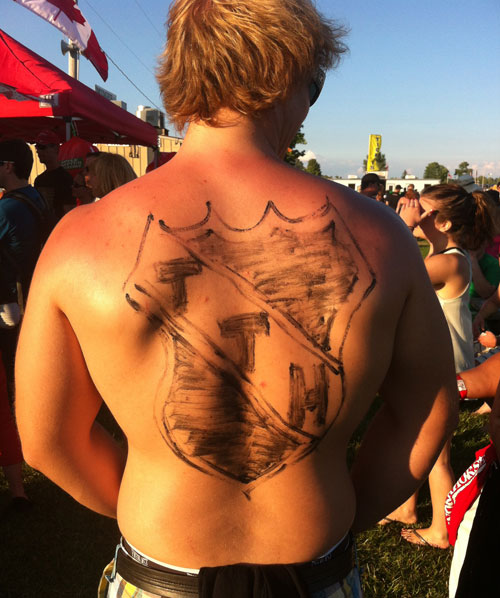
A young man with a Tragically Hip logo covering his bare back
This year’s potential successors to the Can-Rock throne, The New Pornographers, were entertaining, but somewhat upstaged by what seemed like singer (and honorary Canadian) Neko Case’s slow decent into heatstroke-induced stage banter, which included dry jokes about the band’s punk rockness, and their war against the sun (“Fuck you, sun! We’re playing right in your face!”). 2012’s token Americans Death Cab for Cutie sounded like an unfortunate mix of Treble Charger’s less dynamic moments and Jimmy Fallon parodying indie rock, but some of the kids liked it, and the band provided a nice dinner and/or campsite break for the rest of the audience who had been on-site all weekend.
Satisfactorily sated, rested and smoked up, the crowd returned en masse for The Hip. Downie took to the stage with a message about music’s ability to unite people, and his fans’ behavior during the band’s two hour, career-spanning set certainly did a lot of to support his hypothesis.
The biggest temporary beer tattoo-sporting (and permanently beer-gutted) drunken hoser united with the most bookish and bespectacled hipster as they negotiated the polysyllabic and thematic gymnastics involved in singing along to “Poets” and “At the Hundredth Meridian.” Rockers and activists alike hoisted their lighters (one of the charms of small town concerts is that people still generally eschew the cell phone for the more traditional source of ballad-accompanying light) for the David Milgaard-inspired “Wheat Kings.” And everyone chuckled when Uncle Gord embarked on twisted monologues about his complicated relationship with his microphone stand (he seems to hate the stand, but sometimes feels like the mic itself is the only one listening to him) and warned “Wheat Kings ” guest singer Sarah Harmer about wearing an old hat of his (“I can’t let you do that! I got conjunctivitis from that hat at Ontario Place in 1983. It’s an eye thing.”).
The Tragically Hip’s Gord Downie performs on Canada Day 2012.
Objectively, it wasn’t the Tragically Hip’s greatest or most accomplished set ever. While drummer Johnny Fay, bassist Gord Sinclair and guitarists Rob Baker and Paul Langlois remain as solid as ever, Downie’s increasingly shouty vocals and erratic stage presence and the band’s musical divergences sometimes cross the line from interesting into ill-advised. But, at this point in their storied and varied career, The Hip have certainly earned the occasional divergence and they’ve moved far beyond the need for objectivity. The band have become part of the country’s creative mythology and seeing them perform has become an experience that transcends the occasional blown note or hint of boredom (we suspect that Downie is taking the piss when he sings “Blow at High Dough” these days).
Like any good family reunion, a big Tragically Hip festival is a reminder of all that our people are and can accomplish, from the embarrassing to the bizarre to the truly great and heartwarming. And as long as we have our favorite weird uncles in the Hip around to remind us, Canadians can stop and take a little pride in the strange balance of hoserism and intellectualism inherent in our national consciousness that could make a band like T he Tragically Hip big enough to stage this kind of festival to begin with.
This story originally ran July 2, 2012 on Spinner.com.
This made the list at #10 because of a begrudging acknowledgement that, yes, technically it’s a very good album. I can’t, however, shake the notion that the subject matter (restless youth, suburban angst) is something that pop-punkers have been singing about for 25 years. Which makes it not nearly as brave and world-shattering a concept as many would suggest.
9. Band Of Horses Infinite Arms
I haven’t listened to this album since 2010 and I see no reason to do so now.
8. Gord Downie And The Country Miracles The Grand Bounce
I’ve always had a tremendous appreciation for Gord Downie’s solo records. After all, to eschew his easy cash register gig in The Tragically Hip to do something like record freak-out hash rock poetry with Dale Morningstar (Coke Machine Glow, 2001) is incredibly bold. The thing is, as Hip albums become increasingly infrequent, Downie’s complimentary solo records are regressing to the mean in terms of musical adventure. And while The Grand Bounce has its moments — “The Drowning Machine,” in particular, reveals Downie’s often hidden dark side — I can’t help but feel it’s the beginning of Downie’s solo output oscillating towards the bar blues he’s better known for.
7. Black Mountain Wilderness Heart
It’s vitally important that Black Mountain exist. After all, without them there’d be a generation of Broken Social Scene-weaned hipsters who’d never think to listen to their dad’s old Zeppelin, Sabbath and Deep Purple albums.
6. The Schomberg Fair Gospel
In truth, it’s the idea of The Schomberg Fair — a punk-powered, banjo-plucking, hallelujah-hollerin’ rock revival — that I appreciated more than the actual music they released. This #6 spot is probably more about hope than actual love for Gospel.
5. Sunfields Palace In The Sun
The subtle charms of this soft-ish rock album from sometimes-Dears member Jason Kent certainly won me over at the time. In the end though I mostly cared about a song called “Desert Son.” If I redid this list today the album would probably be lower.
4. The Black Keys Brothers
Over it.
3. Gorillaz Plastic Beach
It took me almost a decade to realize that Gorillaz — a joke band made up of cartoon characters — was just as good as (and perhaps even better than) Damon Albarn’s other band, Blur. Granted, it took an album with outsized cameos from Snoop Dogg, Bobby Womack and Little Dragon to figure this out, but the fact I even got there is what really matters. “Stylo” is one of the best play-it-really-loud songs I’ve heard in ages and “Empire Ants,” my favourite from Plastic Beach, inflames the imagination.
2. The Besnard Lakes The Besnard Lakes Are The Roaring Night
The initial reason why I loved Are The Roaring Night was because my hockey team went on a huge winning streak when I’d listen to “Like the Ocean, Like the Innocent Pt. 2: The Innocent” as a psyche up song before each game. Gifts like these from the Hockey Gods need to be supported, after all. More recently, though, I’ve been reading a lot of John le Carré books. And while this has given me a suspicious fear of the United States and the nagging sensation that everyone you look up to will invariably let you down, it’s also done a lot to romance the whole idea of Cold War spies and their “tradecraft.” So now when I listen to Are The Roaring Night I not only enjoy the music on it’s surface sonic level, but I can also dig deeper into the loose spy concept/narrative that’s going on in the record as I peruse German daily newspapers waiting for coded messages from Czech operatives.
1. The Black Angels Phosphene Dream
When I looked back at this list and saw the #1 my first instinct was, “Why?” So I listened to it again and reconfirmed that, yeah, this is one badass record. Now, my loyalty to the album isn’t so strong that I wouldn’t consider flipping it with the Besnard album if I redid this today, but “Entrance Song,” “Bad Vibrations” and “Phosphene Dream” all explore that darker, more dangerous side of psyche rock I find so exciting.
Other album lists…
2015 Top Ten — SUUNS + Jerusalem In My Heart SUUNS + Jerusalem In My Heart is #1 2014 Top Ten — Sharon Van Etten’s Are We There is #1 2013 Top Ten — M.I.A.’s Matangi is #1 2012 Top Ten — Dirty Ghosts’ Metal Moon is #1 2011 Top Ten — Timber Timbre’s Creep On Creepin’ On is #1 2010 Top Ten — The Black Angels’ Phosphene Dream is #1 2009 Top Ten — Gallows’ Grey Britain is #1 2008 Top Ten — Portishead’s Third is #1 2007 Top Ten — Joel Plaskett Emergency’s Ashtray Rock is #1 2006 Top Ten — My Brightest Diamond’s Bring Me The Workhorse is #1 2005 Top Ten — Black Rebel Motorcycle Club’s Howl is #1 2004 Top Ten — Morrissey’s You Are The Quarry is #1 2003 Top Ten — The Dears’ No Cities Left is #1 2002 Top Ten — Archive’s You All Look The Same To Me is #1 2001 Top Ten — Gord Downie’s Coke Machine Glow is #1 2000 Top Ten — Songs: Ohia’s The Lioness is #1 1999 Top Ten — The Boo Radleys’ Kingsize is #1 1998 Top Ten — Baxter’s Baxter is #1 1996 Top Ten — Tricky’s Maxinquaye is #1








 Risky Fuel