One of the most fascinating films Sarah discovered at the Toronto International Film Festival this year was The Dead Lands, a movie about the Maori martial art Mau Rakau.
She talked to director Tao Fraser as well as some of the cast members when they were in Toronto.
You can read about it by heading over to Fightland here.
Last night someone dumped numerous hacked nude, intimate photos of female celebrities like Jennifer Lawrence and Kirsten Dunst on the internet.
This morning I said the following about it on my Facebook wall:
“I think today’s learning lesson is that under no circumstance should you ever taken nude photos of yourself with your phone. Or, probably, ever. For any reason.”
It was then brought to my attention very quickly that this response constituted victim blaming.
On more thoughtful analysis I’ve got to concede that it’s true… it was victim blaming. That wasn’t my intention, though. I just wasn’t looking at this as a human issue, a violation, I was looking at it as a data issue.
As in…
a) If you own a smart phone, computer or tablet, and …
b) You create, then store and/or transfer sensitive images and material…
c) By definition of the various terms of service everyone has agreed to for various apps, devices, softwares, etc…
d) As well as proven tinfoil hat truths exhibited by Snowden and the existence of algorithms that can detect boobs. Then…
e) It’s reasonable to conclude that no binary digital data a person creates can at present be considered safe, “private” and/or secure. Therefore…
f) The only way to prevent nude photos of yourself ever leaking on the internet is to never take them.
Looking at the photo hacking issue strictly through this lens, I now realize, is inadequate.
This, because, although “no nude pics ever” may provide a technically perfect solution to not having one’s intimate vagina photos circle the internet, it doesn’t actually do anything to punish the hackers/invaders/digital pervs. And, more importantly, it doesn’t address the fact that these people have violated the autonomy of another human being. These creepers essentially committed targeted digital attacks on a series of women. This, all right-thinking people can agree, is wrong.
So, if my solution was inadequate, what can us fellas do to man-up about this?
Well…
1) Don’t do things like hack women’s phones, emails, etc. And don’t participate in that spreading-photos-of-your-ex culture (that’s actually mentally insane, bro). This stuff seems obvious, but it probably needs to be stated as baseline. If in doubt, don’t contribute to evil.
2) Don’t enable it. Look, it’s not a crime to wonder if McKayla Maroney’s thigh muscles are bigger than yours. But by actively clicking/hunting/seeking these hack photos, you’re part of the problem. If you want to look at McKayla Maroney pics, her Instagram account is probably the exact amount she wants strangers to see of her. And no more than that.
3) Dick pics. “Yeah, well. Male athletes and boy bands get hacked, too,” I said, trying to argue a certain equality. And yes, when male celebs do get hacked it’s just as much a violation to them as it is when it happens to women. The flipside — and it’s a vital tangental connection to all this — is that when celebrity dick pics surface a percentage of these pop ups happen because dudes have sent unwanted, unsolicited nudes to women.
We can all establish this is gross, right? Apparently this a problem women have to deal with all the time (I had no idea, honestly). I don’t understand it and I’ve got no data to back this up, but this has got to be an even less effective courting technique then yelling, “Nice tittttsss, baby!” at a woman walking down the sidewalk. So let’s keep it simple fellas: any unsolicited dick pics you’ve ever sent to a woman are allowed be distributed to, and roundly mocked in a public manner by her and all her friends. And if you suffer an Anthony Weiner-like fall from grace because of it, well, you deserve it.
4) Freedom. If, like me, you continue to have an imperfect-though-wanting-to-be-sympathetic grasp on the gender-safety-equality issues surrounding this, you should still be able to understand it from a liberty-and-ramifications perspective.
Basically, when the spectre of internet creepoids peeking in the digital drawers looms over all women then that means they can’t do and act as they want. When women can’t act and do what they want, that means their liberty and freedom is being taken away. This, fundamentally, is not right.
For a tourist destination overflowing with natural beauty, immaculately cultivated gardens and classy, upstanding attractions like an aviary and a butterfly conservatory, Niagara Falls doesn’t exactly have the most pristine reputation.
It’s not entirely undeserved.
In a country where nature and its wonders are generally regarded with respect, reverence and stereotypical Canadian politeness, the response to Niagara’s thundering falls has always seemed a bit garish. For over a hundred years, people have been throwing themselves over those falls in various contraptions, or traipsing across them on tightropes. And for over 60 of those years, entrepreneurs have been building wax museums, haunted houses and arcades right next to the water in a less than subtle attempt to capitalize on the bustling tourist trade that the Falls — and its daredevils — inspired.
But anyone who outright dismisses modern day Niagara Falls as a tacky tourist trap is missing the point, and a lot of fun. The Clifton Hill area of town, ground zero for strange and ridiculous amusements, has developed its own charm over the years and a number of its most notorious attractions have proven themselves to be genuinely cool despite — or maybe even because of — their kitsch factor.
Perched at the top of Clifton Hill, this haunted house provides a mix of modern and old-timey scares.
Why it’s notorious:
It’s one of five haunted houses within screaming distance of the Falls, and one of three right on Clifton Hill. The large stature of Frankenstein eating a cheeseburger that straddles the attraction’s roof and the neighbouring Burger King, a rather bizarre but inspired example of corporate synergy, has become a favourite symbol of the city’s tackiness among travel and food writers.
Why it’s actually cool:
It has the most genuine old school carnie atmosphere in town. There are many venues on The Hill that pipe audio tracks onto the street and promise cheap thrills and frights to passersby, but while others merely list their spooky offerings or devolve into music, Frankenstein’s spiel sounds genuinely scary and enticing. With lines like, “When you climb the 13 haunted steps, you are on your own” and “finish this journey of terror… or be lost in the clutching darkness forever!” blasting from its gargoyle-laden facade, this house does the carny tradition of barking or “outside talking” proud. And the inside, which is renovated every February to keep repeat chill-seekers on their toes, almost lives up to the hype.
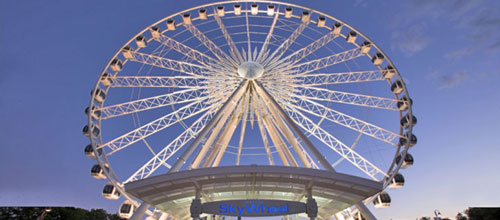
Located in the heart of Clifton Hill, this 175 foot tall ferris wheel with climate-controlled gondolas offers a unique sight-seeing experience year-round.
Why it’s notorious:
It’s a giant ferris wheel in the middle of town.
Even among its over-the-top surroundings The SkyWheel seems a little out of place. In context of the unassuming residential parts of the city, it looks particularly odd.
Why it’s actually cool:
The view! At the very top of the wheel, there’s a little something for everyone. The spectacle of Clifton Hill, the glam Fallsview area, the normal city beyond tourist town and, of course, the Falls themselves all get their due on this short-but-sweet ride. Clocking in at about a dollar per minute, The SkyWheel isn’t the most cost-effective deal on the strip in terms of actual time, but that view really is worth every penny. And, when it’s gussied up in glimmering lights at night, the wheel itself isn’t too shabby-looking, either.
Right next to The SkyWheel, this arcade is the all-ages answer to Casino Niagara and Fallsview Casino.
Why it’s notorious:
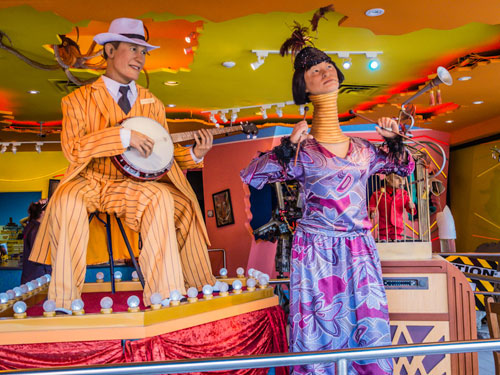
Loud, gaudy and chock full of silly games and rides, the Midway is quite possibly the most absurd attraction in Niagara Falls, which would put it high in the running for most absurd worldwide.
Why it’s actually cool:
The people behind The Great Canadian Midway have crafted an atmosphere that’s undeniably fun and contagious. And while that might seem like a simple task, the other arcades on The Hill (the arcade formerly known as Dave & Buster’s and Adventure City) suggest otherwise. All of three places boast many of the exact same games and amusements, but Busters and Adventure City come off as crowded and almost maudlin affairs, sprinkled with intermittent people having perfunctory fun.
Something about the GCM’s high ceilings, neon lights, sounds, staff and the unparalleled collection of old school Skee-Ball machines makes it stand out. It’s a favourite among kids, tourists, people who want the gambling rush without the risk and anyone who wants to feel like a kid again and, when you’re amongst them, it’s hard not to get caught up in the unabashed and unironic fun.
A Clifton Hill mainstay sine 1963, this wacky museum features a constantly changing and expanding collection of strange and, well, unbelievable objects and information.
Why It’s Notorious:
It’s a large collection of gimmicky and bizarre minutiae in a building that’s been renovated to look like a toppled skyscraper mounted by King Kong. It also seems to derive a disproportionate amount of its fame from being “that place with the two-headed calf.”
Why it’s actually cool:
The collection is actually pretty fascinating. And, with over 700 artifacts, including tramp art, shrunken heads, human hair wreaths, and interactive exhibits, it’s a steal at just $13.99 per person. In a city filled with not-so-cheap thrills, Ripley’s is the kind of place where you can spend a whole afternoon and still discover something new. It’s also chock full of local lore, including video, facts about some of the most infamous falls daredevils, and a haunting display about the hermit who lived on Goat Island.
Located just up the road from Clifton Hill, at 6768 Lundy’s Lane, The Flying Saucer is a classic ‘70s diner with a not so classic theme.
Why it’s notorious:
It’s a diner shaped like two giant UFOs.
Why It’s Actually Cool:
It’s a diner shaped like two giant UFOs! How could that not be cool? The thing that really elevates The Flying Saucer to the next level, though, and makes it the king of cool kitsch in Niagara Falls is the complete dedication to its theme. Sitting inside the diner, with its USS Enterprise-meets-disco decor and its menus designed like tabloids, it’s clear that the place was not the work of someone who halfheartedly slapped a space theme on the place to attract more tourists. It is a sparkling silver monument to geekery at its finest. The food and prices aren’t half bad, either.
This story was originally published Feb. 15, 2012 on AOL Travel (RIP).
I try to avoid cliche in my writing and my life, but when it comes to my hometown of Welland, and the Niagara Region as a whole, absence really has made the heart grow fonder.
After a lifetime of escape plots and fantasies, I felt my first pangs of homesickness on the very first day of my big city internship at the Space station when I was 18 years old. My first task of the day was to sort through a pile of press clippings when I found a snippet from the Welland Tribune. I picked up the flimsy piece of newsprint and actually sighed. Over the Tribune. A paper that I’d been not-so-lovingly calling “The Turbine” in tribute to its rampant typos and awkward headlines since I first learned what those things were.
After that, my detached fondness for the area became far less ridiculous. Welland and St. Catharines started to develop cultures, and, from a distance, I was finally able to appreciate them. I was also able to look at more established and well-known cities like Niagara Falls and Niagara-on-the-Lake in a new light. Once I stopped hating the region for not being Toronto, I was finally able to appreciate all the good ways in which it wasn’t quite like my beloved but imperfect new home. I was also able to get excited about them. I even, occasionally, got to write about everything from music videos being shot on Welland’s retired drawbridge to a travel story on the area’s best kitsch to a surprisingly controversial article about Deadmau5’s feelings on the plethora of haunted houses in Niagara Falls.
As both a Niagara Region expat and a culture writer of sorts, I was very excited about the inaugural Niagara Integrated Film Festival, a celebration of local wine, food, and a mix of local and international film, that took place in St. Catharines and Niagara-on-the-Lake from Thursday, June 19 to Sunday, June 22. The idea of drinking moderate to copious amounts of the region’s most famous industry while watches the offerings from the region’s up-and-coming film industry sounded right up my alley.
Unfortunately, NXNE and family obligations (watching Pizza Underground on a streetcar and attending a lovely garden party in Welland) kept me from enjoying the first batch of screenings and an impressive-looking kick-off party at St. Catharines’ Market Square (home of all my favourite SCENE Fest memories) that featured a bevy of local food and drink offerings. And being a freelance writer for a living kept me from attending the lavish, $150 a head Film Feast events that included dinner, drinks, and an outdoor screenings at some of the area’s finest wineries like Trius and Peller. I did talk to a couple of people who went to one of the Trius events, though, and they said that it was downright incredible. They would have gone to more if their budget had permitted it.
I was able to attend one of the fest’s daily cocktail events and a couple of screenings, though, and rather enjoyed my integrated indulgences. The cabernet shiraz, in particular, was delicious. The films were also a little intoxicating in their own way.
With a limited amount of time and a seemingly limitless amount of latent home region pride, I decided to focus on films from the Niagara Rises program, which included short and feature-length films that had been produced, written, animated, or directed by people from the Niagara Region.
I started with Cas & Dylan, an award-winning film produced by Niagara native Mark Montefiore which screened at the White Oaks Amphitheatre on Saturday night. The venue itself left a little to be desired. Despite its rather grand-sounding name, it was really just a conference room in the White Oaks hotel and spa, and our seats were a mishmash of office chairs.
The White Oaks Amphitheatre
But the content of the film, an off-kilter buddy and road trip movie featuring a terminally ill doctor (Richard Dreyfuss) and a young, slightly aimless writer (the perfect Tatiana Maslany), was the exact opposite of a letdown. It was funny, charming, and came with an ugly-cry-inducing ending that wasn’t forced or cloying in any way. It was a tear-jerk that had been earned by the film’s smart writing and natural performances.
Sunday, I started my day by heading over to another old Niagara haunt, the cineplex at St. Catharine’s Pen Centre, now called Landmark Cinema, for an afternoon screening of The Angel Inn.
I was excited about this film in particular because it wasn’t just by a Niagara filmmaker, it was clearly set in Niagara, and proudly used local landmarks like NOTL’s beloved Angel Inn pub and hotel in its story (even if the interiors had to be shot at another bar). The film itself was… well, let’s just say that it was well-meaning. It was nice to see so many Niagara locations in a film, and particularly wonderful to see them as themselves and not disguised as American cities on film, but the actual content of the film won’t necessarily do much to temper the region’s massive inferiority complex about the quality of its own art.
After that, I headed back toward White Oaks, but a massive police investigation was blocking a significant portion of the main (and only) route to the complex, which thwarted all of my efforts to take in an evening of screenings and more wine. So I retired back to my family compound in Welland and settled in for a night of Niagara Rises screeners instead.
My mini film festival was impressive both in terms of diversity and quality. I was particularly impressed with Steak Juice, an understated but arresting short about an underground fight ring for junkies and the limits of brotherly love, and A Kind Of Wonderful Thing, a feature-length film written and directed by St. Catharines native Jason Lupish and shot in locations around his hometown. The story of a disconnected young woman who is diagnosed with terminal cancer, A Kind of Wonderful Thing has the dreamy, laconic quality of early Atom Egoyan films and its circular flashback sequences somehow manage to be both an accurate and beautiful portrayal of the obsessive and cyclical way that people look on their own pasts.
The film is a testament to how much has changed since I left Niagara to pursue my own arts career. The next generation of Niagara creative types doesn’t seem to feel the same pull to leave that I did. I grew up hearing that nothing could happen in Niagara – or even to someone from Niagara – but that no longer seems to be an issue. I first noticed this trend when I interviewed George Pettit from the dearly departed Alexisonfire for the dearly departed Chart Magazine. I asked him how it felt growing up in a region with no belief in a future for artists, or even a belief in artistic aspirations, and he genuinely had no idea what I was talking about. He told me that it had never been an issue for the band.
When I talked to filmmaker Jay Cheel about Beauty Day, his documentary about St. Catharines’ proto-Jackass Cable Ten hero Captain Video, during Hot Docs in 2011, he said that he was perfectly happy to stay in Niagara and build his career there. He could always make the two-hour drive to Toronto for meetings, and everything else he needed was at his fingertips, from talent to equipment to subject matter, was in the region.
Now that the homegrown industry is starting to establish itself, I hope that the stories it tells continue to become more Niagara-centric as well. Of the Niagara Rises films I watched, The Angel Inn was the only one that was overtly about the region. (There were two other Niagara-focused projects in the festival, a documentary on local wineries called VineLife and a short based on the fallout from the War of 1812, but I couldn’t source screeners for either of them.) I felt that some films had a certain Niagara-vibe. A Kind Of’s slightly-detached beauty, for instance, felt like the kind of perspective that could only come out of being just a couple of hours away from the biggest city in the country, just on the edges of Toronto’s shadow. And I can’t imagine that Dead Before Dawn would have tackled its zombie/demon (“zemon”) plot with nearly as much playful camp if its director and star April Mullen hadn’t grown up in Niagara Falls and shot portions of the film in her hometown. But maybe I’m reading into these things, to use a Welland colloquialism, way too much.
What I really want to see, though, are undeniably Niagara stories. The region is full of fascinating tales and inspiration and so few of those them have been told outside of the occasional historical piece on the War of 1812 and Laura Secord. It’s a region split between natural beauty and largely abandoned factory land. Its biggest industries are wineries and call centers. It is both classy and aspirational, and trashy and kitschy. And it is, under the surface, fascinatingly weird. I have, on more than one occasion, called it “Twin Peaks without the Black Lodge,” but I kind of suspect that there actually is a Niagara version of the Black Lodge and I just haven’t found it yet.
I want to see, hear, and read about all of these things, and I’m really hoping that NIFF will continue help to foster those stories and deliver them to the world.
I also want to see NIFF continue to reach out to unique Niagara venues. I can’t possibly be the only person who thinks a festival night at the Can-View Drive-In would be the best thing ever.
Because it’s Canada Day the folks at Huffington Post Music Canada enlisted Team Risky Fuel to help compile their 100 Best Canadian Songs Ever.
There were a couple rules: an artist can only appear on the list once, and, we would try to represent every genre and modern Can-pop time period in some way shape or form.
The results were… divisive. But that’s kinda the point.







 Risky Fuel