Nine Inch Nails’ Trent Reznor
And All That Could Have Been.
Hidden in those simple words are a virtually innumerable number of meanings. Part epitaph for the glory days of the alternative music revolution, part multi-pronged marketing assault by Trent Reznor and his Nine Inch Nails project and part symbolic dip into the many facets that make up NIN, all the things that currently are include a DVD, a live CD, a “stripped down” CD, a remix CD, a VHS and possibly a closing of a chapter in the history of Nine Inch Nails. After all, NIN have been around for 13 years and Trent Reznor is promising to boldly go where he hasn’t gone before…
The Frail
Trent Reznor’s about 12 minutes into a very subtly crafted condemnation of everything we hear these days. Few bands are mentioned by name, and fewer still can even be guessed at in concrete terms. But the sentiment is there.
Coming from the man who’s vicious sloganeering — Step right up, March! I wanna fuck you like an animal! — represented the most dangerous fringe of popular music in the last decade, anger has become almost too easy a well to tap. The greater artistic challenge now is to become all the things that could be.
“It took me a long time to gain the courage to not just make the music that would be expected — which would be tougher, harder and meaner or more punching you in the face,” says Reznor. “That’s easy to do and safe for me to do now. I’ve seen a lot of bands fall into this trap — especially recently — fall into this trap of hard, faster, faster, harder, noisier, louder, more bad words in it. It doesn’t equate to being more intense. It becomes just cartoonish after awhile.”
And like any good rebel, Reznor is trying to define himself by not being like his cartoonish colleagues.
“One of the ways in which I’ve tried to keep Nine Inch Nails expansive is to — I realized that I can write a Broken-type album — and I can mean it. But, the same night I can play something melancholy and sad on the piano. I used to be afraid to put that on the same record.”
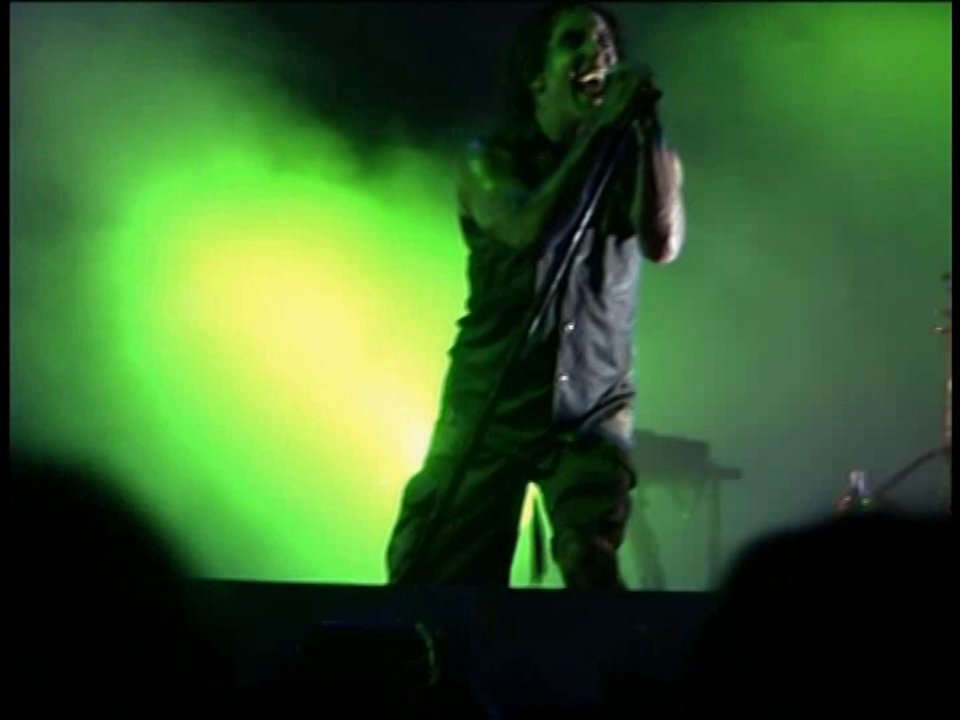
Reznor seems to have taken up that challenge. Though the live album And All That Could Have Been captures the violent intensity that defined the typical NIN show, it was also accompanied by a second album called Still which was primarily a record of piano-balladry.
Considering Reznor is no longer the alpha male of the testosterone rock underground, an album of piano ballads seems an unlikely choice to enable him to recapture that throne. But for Reznor, a notorious perfectionist, being the king of the castle doesn’t have all that much allure.
“I’ve made the music I liked and a one point, The Downward Spiral era in particular, a lot of people seemed to like the same thing,” he says. “And that’s good and bad. It’s good because I got some rewards from that, I’m glad I turned a lot of people on to that music. But now it kinda haunts you in that your expectations, your commercial expectations are set so high that do I as an artist try to think, ‘Well fuck! What do they like about that? Maybe I can do more stuff like that.’ Then I’ll get rewarded and everyone will be happy… except my soul will decay because I’m not doing music that matters to me anymore.
“I’m not going to tell you there hasn’t come a time with me going, ‘Oh my god, Head Like A Fucking Hole.’ Again.”
March Of The Pigs
As tired as “Head Like A Hole” may seem to Reznor, that song was a theme of sorts for one of the most vital and dangerous musical movements in recent memory — industrial-alternative (and for the record, grunge wasn’t new and vital, that was just rock music in plaid).
In 1989, the world of music was a much different place. Pre-packaged hair metal ruled the day. Guns N’ Roses held the tough front for boys and for the girls there was Poison.
These were flippant, disposable times. But if you scratched just beneath that musical surface, actually, scratched until you were bloody and raw, you’d find something more primal lurking there.
In the dark underground nightclubs this new rave culture was getting its joy stolen and repackaged into the fascist beats of Nitzer Ebb’s glorious industrial-house. At the same time, a band called Ministry were awakening from their bad Erasure obsession, melding ferocious bpms, Sabbath guitars and eerie samples into brutally anthemic The Mind Is A Terrible Thing To Taste.
Still, with these cornerstones for the true alternative nation in place, there was one thing missing — a leader.
That’s where Nine Inch Nails came in.
While grunge was still almost four years from breaking big, the release of Nine Inch Nail’s Pretty Hate Machine represented a sort of cosmic force uniting freaks, loners, noise aficionadoes, disco casualties and bored metalheads. And that force was powerful.
Pretty Hate Machine, and its subversive hit “Head Like A Hole,” wrapped up all the anger, all the loneliness, all the outsiderism and jammed it into one album which sounded like the sonic equivalent of invasive surgery. But you could still dance to it.
Fast forward to 1992. After stealing the show at the first Lollapalooza, NIN released Broken, what will likely stand forever as the single most defining amalgam of heavy metal, industrial dance beats and a secret, yet healthy helping of pop sensibilities.
By this point Reznor’s chiseled cheekbones and particular sense of mope made him a cult hero. Two years later he would explode into a bonafide angst rock superstar with the release of The Downward Spiral.
Little did we know at the time, but that title would be prophetic.
As NIN’s popularity peaked, the number of pipe-banging rockers ballooned. Names like the aforementioned Ministry and Nitzer Ebb, along with Skinny Puppy, Revolting Cocks, KMFDM, The Young Gods, Front 242, Stabbing Westward and a whole host of others were marketed and packaged (and ultimately, co-opted) to try to capitalize on the trail NIN had blazed. It would be to the scene’s ultimate detriment.
“I think there was a time where we emerged out of where the Wax Traxx scene was going where it seemed like there was a lot of promise,” says Reznor, reflecting on the subsequent rise and fall of industrial rock. “It was a new form of aggressive music that you hadn’t heard before. It wasn’t a throwback to ’70s rock because ’70s rock didn’t have drum machines and ’70s didn’t have the production values that Skinny Puppy had. There was a real excitement back then, I remember just feeling really part of this clique and was thrilled when I got accepted into it and was playing onstage with Revolting Cocks, with some of my heroes.
“And I think what happened was a couple things: One was that when we started to get popular a lot of major labels came in and started to sign up everyone else that sounded anything like us. So that meant that Front 242 get signed and make a terrible album. And Skinny Puppy get signed and get drugs and go hide off in the woods somewhere and don’t make a good album. And Ministry were already signed… but you just saw a lot of bands spiral out of control.”
Of course, hindsight always helps give perspective on these things. Too much money being thrown around, too high expectations and an overestimation of how popular this violent form of music could be all contributed to these bands demise. But the number one factor involved was probably greed.
“You can blame that on major labels,” says Reznor, bluntly. “But I can also blame that on musicians and their responsibility. Now I’m not talking about drugs or anything else. I’m talking about — I’m trying not to get on a soapbox here — but it’s real easy to sit around and bitch about bands that are successful. But then someone goes, ‘Wow. Hey, do you want a record contract?’ ‘Uh, yeah.’ And you see all these guys jumping through hoops and giving in to corporate pressures of ‘Make your record sound like this.’ ‘We’re going to give you a lot of money, but you’ve got to do this.’
“What do you think American Records thought when they signed Skinny Puppy, probably under the pretense that Nine Inch Nails sounds like them? And [Skinny Puppy] turn in something that doesn’t have a big hit single with a glossy video? But that’s what happened. And I do know that they self-destructed by the time they signed with a major label.”
Reznor follows this with a simple statement that applies to not only his own special niche of PVC warriors, but to virtually every popular music scene.
“I would be hard pressed to name a band that really compromised their integrity then got really successful for a long period of time,” he says.
Something He Wants To Have
Nine Inch Nails followers know all about Reznor’s personal sense of integrity. On one hand it represents a quality control mechanism you only wish Billy Corgan possessed. On the other, it makes for often frustrating periods of anticipation for NIN fans.
Whether it was The Downward Spiral, The Fragile or the latest series of multimedia releases, Reznor’s need to get it right has consistently meant release date delays and if reports, inferences and the perpetual swirl of fanclub rumours are to be believed, multiple music projects shelved indefinitely, never to be heard by the music consuming public because Reznor doesn’t feel them worthy.
All this makes does is make the scope of the And All That Could Have Been release that much more surprising. Originally, it was strictly supposed to be a live DVD project. But somehow it ballooned into its multi-headed format.
Reznor considers the live performances which took place on the Fragility v2.0 tour of 2000 to be amongst the best performances he’s done live. At the time, he felt Nine Inch Nails were actually a “band” and not just his vanity project.
“Now it’s just me again,” he says, quickly correcting any inferences that NIN has evolved into a permanent multi-person unit. “When it’s live, the people, especially in that incarnation that’s on the DVD and CD, they were people I respected and I thought understood the music so it was their interpretation of my music. It wasn’t me riding them about stuff and they were given room to make it their own. And in that way when we play live it is a band. And it is a band, not just me.
“But right at this moment I’m working on stuff alone in the studio. I’ve come to the realization that I’ve always had this romantic notion that Nine Inch Nails could be a semi-democratic band like bands I’ve always envied like The Smiths, U2, The Stones, where there’s musical identities in the band.
“I’m making some inroads into some other band-type project that probably isn’t Nine Inch Nails that probably is more collaborative. That’ll probably be how that format comes out…”
So NIN is a band, but it’s also a solo project. And Reznor’s currently in the studio doing new work, but if he doesn’t like it you may never get to hear it. And if it’s not appropriate for NIN, his next musical project may be a band. Clearly, Reznor wants to be everything he can be.
It’s all very confusing and a little bit unsettling, but what may cause the greatest amount of trepidation about all of this is the symbolic meaning which often follows the release of something as comprehensive as the And All That Could Have Been project.
Is this a bookend? The end of an era? Will Nine Inch Nails forever change its direction?
“I don’t think that’s going to be the case, but the type of show from Nine Inch Nails that people have come to expect I think is going to be taken to something different,” he says, just before flashing a bit of his often overlooked gallows humour. “It won’t be five-piece, keyboard-smashing, corn-starch covered retards onstage. We’re going to put maple syrup on us next time.”
This story originally appeared in Chart Magazine’s March 2002 issue, #134.