City And Colour’s Dallas Green and snarly pop singer Pink totally have music boners for each other. So it was kind of inevitable that when Dallas was in Los Angeles last week, Pink showed up at his show, jumped on stage and did a song with him.
Aaron wrote about it for Spinner and you can find out more by clicking here.
UPDATE: Because Spinner is RIP this story can now be found in full here.
Boots Electric, better known as Jesse Hughes, the lead singer for Eagles Of Death Metal, has been letting the world know about his new funk rock solo album Honkey Kong. He’s also been talking about his live show, which includes covers of songs by Amy Winehouse and Olivia Newton-John.
Boots recently told Aaron about how he dug Amy, but the people around her were “vipers and sharks.” You can read the whole conversation over at AOL Spinner by clicking here.
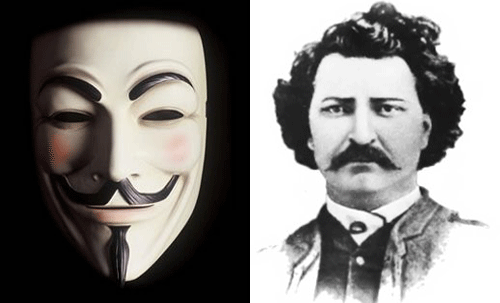
Both of them were tried for treason and sentenced to hang, and both of them are now considered rebel icons of a sort, but really, who does it better? Louis Riel, the spiritual leader of the Metis people, or Guy Fawkes, whose plot to kill King James I of England has been iconized and commodified for the modern era.
Screw You To The Government
Riel: Was elected to Canada’s House Of Commons on three separate occasions, though he never assumed his seat for fear of assassination.
Fawkes: Plotted to blow up the British House Of Lords and assassinate King James I.
Verdict: Blowing up a building’s pretty coarse and obvious, but not being able to show up for work because someone’s gonna shoot you in the head? That’s being a rebel. Point Riel.
Video Games
Riel: Somebody took the time to make this.
Fawkes: There’s a character named “Fawkes” in the post-apocalyptic shooter, Fallout 3.
Verdict: Clearly gamer nerds are more engaged by Fawkes than Riel. Point Fawkes.
Chester Brown's Louis Riel
Graphic Novel
Riel: Chester Brown’s Louis Riel.
Fawkes: Alan Moore and David Lloyd’s V For Vendetta.
Verdict: Moore’s work is the better known, better crafted treatise on rebellion, but Brown’s captures all the complex realities of Riel’s life. Tie.
Badass Death
Riel: When he was hanged it took four minutes before he slowly and painfully choked to death.
Fawkes: To avoid being drawn and quartered while alive, he jumped from the scaffold from which he was to be hanged, breaking his neck.
Verdict: One’s first instinct is to give it to Fawkes for the drama and beating the system, if only a little. But going out in the most ugly, painful way makes the best act of defiancance. Point Riel.
Music
Riel: Thee Headcoats and Grand Archives have recorded songs about Riel, but the Canadian Opera Company also have a popular opera about the Metis leader.
Fawkes: John Lennon references Guy Fawkes Night on the song “Remember” from the John Lennon/Plastic Ono Band album.
Verdict: In the cosmic scheme of things, there’s no scenario where the Canadian Opera Company will ever be more counter-culture than Lennon. Point Fawkes.
Religious Conviction
Riel: Thought he was creating a new Christian order.
Fawkes: Was a really, really passionate Roman Catholic.
Verdict: Both felt the God in them pretty strongly, but for sheer loopy-ness, Riel’s new Christian order takes it. Point Riel.
Movie
Riel: There was a CBC-sponsored made-for-TV movie back in 1979.
Fawkes: V For Vendetta made $132 million worldwide, starred Natalie Portman and has been adopted by libertarians and anarchists alike.
Verdict: Until Brad Pitt does a starring turn as Riel this one remains a lock for Fawkes. Point Fawkes.
Moustache
Riel: A jailer cut off Riel’s ‘stache prior to his execution, some of the clippings of which are now in the St. Boniface Historical Museum.
Fawkes: Those hacker kids in Anonymous think Fawkes’ moustache makes for perfect desktop wallpaper.
Verdict: There can be no winner in the battle of iconic soup-strainers. Tie.
Official Celebratory Day
Riel: Saskatoon, Saskatchewan used to hold an annual Louis Riel Day, complete with tug-of-war and cabbage roll eating contests. The city stopped celebrating it in the ’90s.
Fawkes: Guy Fawkes Night, also known as Bonfire Night, happens Nov. 5 in Britain and is basically built on the premise of children burning effigies of Fawkes.
Verdict: Cabbage roll eating vs. sinister indoctrination of children under the guise of playing with fire? Hmmm. Point Fawkes.
Symbol Of Rebellion
Riel: The Metis Sash. Generally red, and worn around the waist, it symbolizes that, yes, since a Supreme Court Of Canada ruling affirming it in 2003, Metis’ have the awesome protected Aboriginal right to hunt for food, regardless of season or licence.
Fawkes: The Guy Fawkes Mask. Adopted by G20 protesters, Occupy Wall Streeters, and computer hacking activists, the moustache mask popularized in V For Vendetta is now the brand of counter-culture.
Verdict: Until Metis sashes become as commodified on Amazon as Fawkes masks, this one’s locked in for the Brit. Point Fawkes.
RESULT
And your better rebel icon is… Guy Fawkes. Congratulations. Now go burn or blow up something.
Of the five music-related documentaries that I saw at the Toronto International Film Festival this year, four were about internationally famous pop and rock artists, and the other was about a group of working class musicians who live on the fringes of society in Buenos Aires and perform a style of African-influenced song and dance known as Murga.
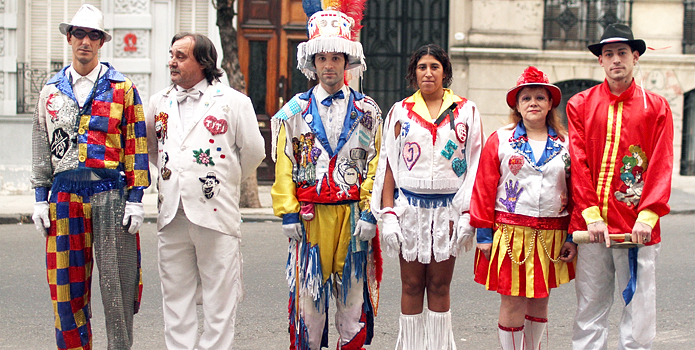
This might sound like a particularly easy game of One Of These Things Is Not Like The Other, but the film, Caprichosos De San Telmo, really isn’t so far removed from its more famous and mainstream counterparts. The group, also known as Caprichosos De San Telmo, might face a different cultural and financial reality than U2, Paul McCartney and Neil Young, but their musical experiences — the sacrifices they make for their craft, the creative process, and the pure joy and beauty of expression — are remarkably similar.
I had a chance to talk to director Alison Murray about the film, the band and the politics of Murga dancing during the festival. Here are some of the highlights:
How did you first discover Caprichosos De San Telmo?
About two and a half years ago, I was walking around in the neighbourhood of San Telmo, pushing my daughter in her stroller, she must have been six months at the time. I was trying to get her to stop crying, and I heard this drumming. I started walking towards the drumming and, as the drumming got louder, she fell asleep. I thought “OK, this works,” so I kept going until I found the source of the noise, and I saw this Murga rehearsing in the park. I was just fascinated by the rhythms and the dancing, but particularly the dancing, because I have a long relationship with dance and filming dance. It just seemed so obviously African, and yet there were no African faces in the group. That led me to explore the history of Africans in Buenos Aires and I learned that there had been a huge African population that’s now pretty much gone.
Did you know almost immediately that you wanted to make a film about them, or did the idea grow on you over time?
I thought that it would be a good subject and then I think I mentioned it to my producer, Kathleen Smith, who I work with a lot and she said I should do it. It was long after that that I just took my camera and started shooting kind of randomly, not really knowing if it was going to lead anywhere or not. And once I started, it kind of gained momentum and I realized that it was going to be a project worth completing.
Were the members of the group reticent when you first started showing up with your camera?
Not at all. They loved it. In particular, some of them were real kind of clowns who jumped in front of the camera every chance they could. And that’s my experience with documentary making, at least for me. I made a film about carnival workers in the U.S. and also about people hopping freight trains and often people really like to be filmed. If you’re respectful and you’re not making a spectacle of them and it’s not kind of a reality TV treatment, then I think people feel validated by having someone who’s interested in their lives and it makes them feel good.
Did you know anything about the Murga before you discovered Caprichosos?
No. I didn’t know what it was. I didn’t know the origins. Nothing. I just encountered them. I went to Buenos Aires because I was interested in tango, and I didn’t realize there were other dances that were part of the culture of the city as well, like Murga.
Pop culture seems to have some influence on the group, at least in terms of the way that its members decorate their costumes with famous logos and characters. Is it also an influence on the music and the dance?
That’s an interesting question. That’s a kind of controversial question, in a way. Some of them have Bart Simpson or The Rolling Stones tongue on their costume, but other people have Che Guevara, which is very political. So there is a little bit of interchange with pop culture in that respect. But in terms of the dance, somebody said to me once, “Oh yeah, but those movements that those guys are doing, that’s from hip-hop, that’s not Murga.”
Well, hip hop-has African routes as well as Murga has African roots. You can say that’s not traditional Murga, but it’s coming from the same source, so I think it’s all valid. Amongst some of the dancers, there was some contention over whether something from hip-hop fit into their vocabulary. You could see movements in hip-hop and other movements in Murga that probably have both come from African dance somewhere along the lines, but the Murga dancers didn’t learn those moves from watching MTV, they learned them because they’ve always been in the Murga vocabulary.
Do you think that the Murga is a malleable art form?
Yes. Definitely. You can see different communities and different neighbourhoods have a distinct style in each area, but that’s starting to change a little bit now. Pichi, the leader of the group that I filmed was a little bit disparaging of that because he said that… it’s a double-edged sword. There’s a little more support for Murga in terms of them getting grants and things, but that means that there’s people who are learning Murga and then going into another community and teaching it, like teaching it in a community college. That’s a new thing that’s just started. Pichi doesn’t like that because he thinks each Murga should develop its own style within the neighbourhood, and if people start traveling around the city, taking different styles in different places, then those styles are going to get all mixed up and watered down. I don’t necessarily think that’s a bad thing, but he’s a little uncomfortable about that idea.
I loved Pichi’s story in the film. He’s almost like KISS or Cher, in the way that he keeps threatening to retire from music. Is he still with the group?
Oh yeah. I don’t think he’s ever going to stop, and this film is just kind of given him more passion to keep on going.
There’s a new Sigur Ros concert film called INNI that’s been making all the hipster film nerds crazy with its grainy black-and-white footage, its intimate up-nose camera shots and other goodness.
Sarah spoke to director Vincent Morriset about the film for Spinner Canada. You can read about it by clicking here.







 Risky Fuel