Update 1/5/14: Because Spinner is RIP I’ve unearthed this story and it can be read by going here.
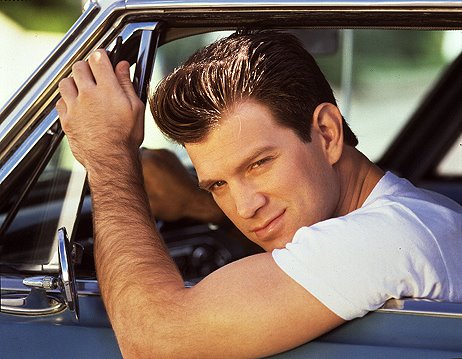
Last month we told you about how Chris Isaak doesn’t like shitty singers. Well, now the companion feature to that story is out and you can read it by surfing over to Spinner Canada here.
This illuminating Q&A features Mr. Wicked Game talking about hanging out with Roy Orbison (jealous!) and how his brother made him pack a straight-razor with him when he went to New York City. Y’know, in case a dance fight broke out or something. There’s other stuff, too, so go read it.
Everyone’s being all scandalized by some woman’s claim that Justin Bieber has fathered her child. Those same people don’t realize that part of this whole process is about massaging Bieb’s image to make him seem more “mature” and get film roles and such.
Anyway, this whole scenario was fascinating to Team Risky Fuel, so Sarah went and spent a whole weekend researching musical paternity cases. Needless to say she knows more about rock star paternity claims than anyone should.
You can read the story at the AOL Music Blog by clicking here.
City And Colour’s Dallas Green and snarly pop singer Pink totally have music boners for each other. So it was kind of inevitable that when Dallas was in Los Angeles last week, Pink showed up at his show, jumped on stage and did a song with him.
Aaron wrote about it for Spinner and you can find out more by clicking here.
UPDATE: Because Spinner is RIP this story can now be found in full here.
Boots Electric, better known as Jesse Hughes, the lead singer for Eagles Of Death Metal, has been letting the world know about his new funk rock solo album Honkey Kong. He’s also been talking about his live show, which includes covers of songs by Amy Winehouse and Olivia Newton-John.
Boots recently told Aaron about how he dug Amy, but the people around her were “vipers and sharks.” You can read the whole conversation over at AOL Spinner by clicking here.
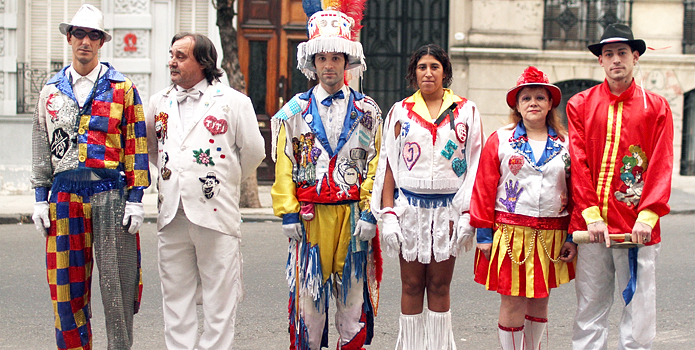
Of the five music-related documentaries that I saw at the Toronto International Film Festival this year, four were about internationally famous pop and rock artists, and the other was about a group of working class musicians who live on the fringes of society in Buenos Aires and perform a style of African-influenced song and dance known as Murga.
This might sound like a particularly easy game of One Of These Things Is Not Like The Other, but the film, Caprichosos De San Telmo, really isn’t so far removed from its more famous and mainstream counterparts. The group, also known as Caprichosos De San Telmo, might face a different cultural and financial reality than U2, Paul McCartney and Neil Young, but their musical experiences — the sacrifices they make for their craft, the creative process, and the pure joy and beauty of expression — are remarkably similar.
I had a chance to talk to director Alison Murray about the film, the band and the politics of Murga dancing during the festival. Here are some of the highlights:
How did you first discover Caprichosos De San Telmo?
About two and a half years ago, I was walking around in the neighbourhood of San Telmo, pushing my daughter in her stroller, she must have been six months at the time. I was trying to get her to stop crying, and I heard this drumming. I started walking towards the drumming and, as the drumming got louder, she fell asleep. I thought “OK, this works,” so I kept going until I found the source of the noise, and I saw this Murga rehearsing in the park. I was just fascinated by the rhythms and the dancing, but particularly the dancing, because I have a long relationship with dance and filming dance. It just seemed so obviously African, and yet there were no African faces in the group. That led me to explore the history of Africans in Buenos Aires and I learned that there had been a huge African population that’s now pretty much gone.
Did you know almost immediately that you wanted to make a film about them, or did the idea grow on you over time?
I thought that it would be a good subject and then I think I mentioned it to my producer, Kathleen Smith, who I work with a lot and she said I should do it. It was long after that that I just took my camera and started shooting kind of randomly, not really knowing if it was going to lead anywhere or not. And once I started, it kind of gained momentum and I realized that it was going to be a project worth completing.
Were the members of the group reticent when you first started showing up with your camera?
Not at all. They loved it. In particular, some of them were real kind of clowns who jumped in front of the camera every chance they could. And that’s my experience with documentary making, at least for me. I made a film about carnival workers in the U.S. and also about people hopping freight trains and often people really like to be filmed. If you’re respectful and you’re not making a spectacle of them and it’s not kind of a reality TV treatment, then I think people feel validated by having someone who’s interested in their lives and it makes them feel good.
Did you know anything about the Murga before you discovered Caprichosos?
No. I didn’t know what it was. I didn’t know the origins. Nothing. I just encountered them. I went to Buenos Aires because I was interested in tango, and I didn’t realize there were other dances that were part of the culture of the city as well, like Murga.
Pop culture seems to have some influence on the group, at least in terms of the way that its members decorate their costumes with famous logos and characters. Is it also an influence on the music and the dance?
That’s an interesting question. That’s a kind of controversial question, in a way. Some of them have Bart Simpson or The Rolling Stones tongue on their costume, but other people have Che Guevara, which is very political. So there is a little bit of interchange with pop culture in that respect. But in terms of the dance, somebody said to me once, “Oh yeah, but those movements that those guys are doing, that’s from hip-hop, that’s not Murga.”
Well, hip hop-has African routes as well as Murga has African roots. You can say that’s not traditional Murga, but it’s coming from the same source, so I think it’s all valid. Amongst some of the dancers, there was some contention over whether something from hip-hop fit into their vocabulary. You could see movements in hip-hop and other movements in Murga that probably have both come from African dance somewhere along the lines, but the Murga dancers didn’t learn those moves from watching MTV, they learned them because they’ve always been in the Murga vocabulary.
Do you think that the Murga is a malleable art form?
Yes. Definitely. You can see different communities and different neighbourhoods have a distinct style in each area, but that’s starting to change a little bit now. Pichi, the leader of the group that I filmed was a little bit disparaging of that because he said that… it’s a double-edged sword. There’s a little more support for Murga in terms of them getting grants and things, but that means that there’s people who are learning Murga and then going into another community and teaching it, like teaching it in a community college. That’s a new thing that’s just started. Pichi doesn’t like that because he thinks each Murga should develop its own style within the neighbourhood, and if people start traveling around the city, taking different styles in different places, then those styles are going to get all mixed up and watered down. I don’t necessarily think that’s a bad thing, but he’s a little uncomfortable about that idea.
I loved Pichi’s story in the film. He’s almost like KISS or Cher, in the way that he keeps threatening to retire from music. Is he still with the group?
Oh yeah. I don’t think he’s ever going to stop, and this film is just kind of given him more passion to keep on going.





 Risky Fuel