Best Canadian Sports Writing, available via ECW Press.
As the year winds down, please consider this a friendly reminder that Sarah had multiple stories published in the Best Canadian Sports Writing anthology put out by ECW Press in the fall.
There’s a more detailed explanation of what’s in the book at the ECW site.
David Bowie likes to flash back into relevance once a decade. Like a passing TARDIS, he enters deep space to cobble together fresh art before swinging by earth once again, delivering shiny new singles.
“Where Are We Now,” the singer’s first release in 10 years is quite a curious tune. It represents a softer phase for a man who has put down the saxophones and the sex, and begun looking back.
Which is odd because there is no past for David Bowie. That is because he lives forever… or at least until his alien organs give out. You see, the Thin White Duke is a Time Lord.
What’s a Time Lord you ask? Well, it’s a humanoid creature from the planet Gallifrey made popular on the BBC show Doctor Who. We’re pretty sure Bowie has been trying to tell us this for about four decades now, so we went ahead and put together some striking evidence. There’s also some SPOILERS below, so if you haven’t seen the most recent season, don’t read this.
Let’s Dematerialize!
The Sound of Time Travel
“Then the loud sound did seem to fade/Came back like a slow voice on a wave of phase/That weren’t no DJ, that was hazy cosmic jive,” Bowie sings on 1972’s “Starman,” pretty much describing the very whooshing noise of the TARDIS.
Watch “Starman”
“This ain’t rock ‘n’ roll. This is genocide!”
The Doctor hates nothing more than when an entire race of aliens are blown to smithereens or killed by superior beings. He wouldn’t even wish total annihilation on his mortal enemies, the Daleks. Bowie’s intro to Diamond Dogs called “Future Legend” speaks of a distant dystopia, filled with “fleas the size of rats [sucking] on rats the size of cats.” He didn’t make it up. Bowie’s been there, and it’s called New New York.
Cosmic Connection to Billie Piper
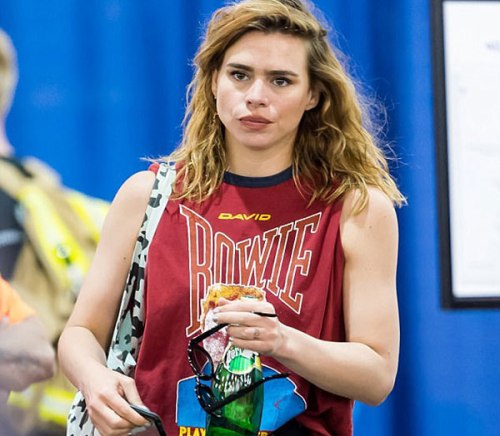
Billie Piper
The greatest — and most tragic — love story in the Doctor Who canon is undoubtedly between “Number Ten” (David Tennant) and Rose Tyler, better known as pop singer and star of the lurid show Secret Diary of a Call Girl, Billie Piper. Thing is, 10 wasn’t the only one with a connection to Piper. Piper and Bowie share a heat as intense as a thousand Cybermen x-ray lasers.
Wibbly Wobbly, Timey Wimey
Changes & Regenerations
If ever there was a song that thinly disguised the existential angst of a Time Lord it would be “Changes” from David Bowie’s 1971 album Hunky Dory. Bowie’s chameleon-like shifts in appearance and personality are all summed up in four simple lines:
Ch-ch-Changes
Just gonna have to be a different man
Time may change me
But I can’t trace time
Indeed, you can’t trace time. In fact, another Time Lord confirmed that (see above video).
David Bowie in a scarf
Love of Scarves
If “Fourth Doctor” Tom Baker proved anything during his time in the TARDIS between 1974-81 it’s that Time Lords love scarves. The fourth Doctor had a signature extra long number that would drag on the ground and need constant adjusting. Not coincidentally, David Bowie loves scarves, too. He’s been photographed wearing an assortment of neck-cessories with a higher-than-normal frequency over the years.
“Still Not Ginger!”
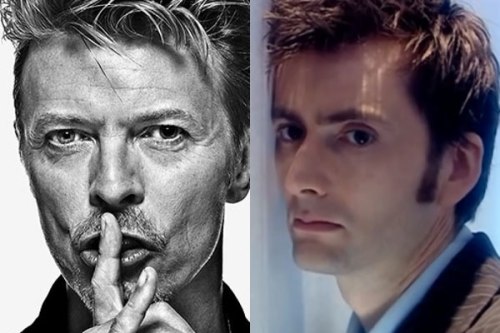
David Bowie
Ginger-Obsessive
Bowie’s Ziggy Stardust era saw the spacey singer as a fiery redhead, a regeneration trait that many a Doctor has sought after, especially “Number Eleven.”
Back in Time With Bowie
The John Simm Connection
John Simm, the actor who played the Doctor’s arch nemesis the Master, also starred as Sam Tyler in BBC’s Life on Mars, a crime drama featuring a policeman who travels back in time. Bowie has a song called “Life on Mars.” And a sequel to the television series was called “Ashes to Ashes.” There’s a cosmic connection here that’s no accident.
This story was originally published January 9, 2013 on AOL Spinner and was co-written with Cameron Matthews.
Neil Young at Massey. (Copped this pic from Toronto Star.)
LIVE: Neil Young
May 10, 2011
Massey Hall
Toronto, Ontario
Neil Young’s sold out Tuesday night show at Toronto’s Massey Hall was billed as a solo performance, but there was another pair of invisible guiding hands at work as well — those of Ancaster-born, U2 king-maker/super-producer Daniel Lanois.
While Young fell short of recreating the dizzy loops, echoes and fades that make his Lanois-produced latest album Le Noise such intoxicating headphone fodder, there was a barely sublimated sonic adventurousness — a hint of musical mischief and menace — that elevated the evening’s set into something more than just Neil. On a stool. At Massey.
Young’s experiencing a bit of a next-gen renaissance thanks to Le Noise, so it wasn’t particularly surprising the 65-year-old grunge godfather leaned heavily on the new album. Six of the 17 songs Young played were from the new record, but it was just as often what he did to his “classic” songs that revealed what his goal for the set was.
House-warmers “My My, Hey Hey (Out Of The Blue),” “Tell Me Why” and “Helpless” were played reasonably straight. The crowd — more sport-jacket and recently trimmed hair than hippie burnout (no doubt the result of a more evolved ability to navigate the minefield that is modern ticket purchasing) — was particularly moved by “Helpless,” going so far as to sing along to the chorus with about the same volume and self-consciousness as Leafs fans doing the first verse of “O Canada” at the ACC.
Rapt silence was the more appropriate response for Le Noise track “Peaceful Valley Boulevard.” A gauzy, sprawling number on record, it was equally haunting live and could fairly match melancholy Young masterpieces like “On The Beach” and “Expecting To Fly.”
The next two songs — Le Noise‘s confessional “Love And War,” and all-timer “Down By The River” — started to reveal the outline of the Lanois impact on Young’s performance. It wasn’t so much about Young copping signature Lanois sounds as it was about watching Young wandering across the stage, coaxing bits of feedback from his amps, or impishly turning the chorus of “Down By The River” into a five-second primer on My Bloody Valentine.
It was this casual tinkering while strolling about the various guitars, pianos and organs which was what making Le Noise must have looked like. Except instead of Young, guitar slung over his shoulder, all poking around Lanois’ house for an audience of one, here he was doing so in front of 2,800 people.
Young’s re-imagining of “Cortez The Killer” was a particularly good example. Its intro disguised by a brief squalling shock, Young eventually emerged from his soundcloud to lay down a version you just knew was exactly like one Lanois might have coaxed him to play while the two were defining the identity of the latest album.
That’s when it became clear what Young was doing. He wasn’t just rote recreating the sounds of Le Noise for the audience last night, he was trying to recreate “the vibe,” as he experienced it, of his own adventure in le noise.
And when he closed the show with the single encore “Walk With Me” and its opened-armed plea “I’m on this journey/I don’t want to walk alone,” he managed to bring a lot of people with him.
Neil Young setlist for May 10, 2011:
“My My, Hey Hey (Out Of The Blue)”
“Tell Me Why”
“Helpless”
“You Never Call”
“Peaceful Valley Boulevard”
“Love And War”
“Down By The River”
“Hitchhiker”
“Ohio”
“Sign Of Love”
“Leia”
“After The Goldrush”
“I Believe In You”
“Rumblin’”
“Cortez The Killer”
“Cinnamon Girl”
encore:
“Walk With Me”
This live review originally appeared in The Grid (RIP) in May 2011.






 Risky Fuel